860 m², 148 KNX devices, 2 020 group addresses — still readable four years after handover
A project from the engineer's professional experience, completed before Tact Automation was founded.
- Floor area
- 860 m²Floor area
- KNX devices
- 148KNX devices
- Group addresses
- 2 020Group addresses
- Years in operation
- 4Years in operation
Overview
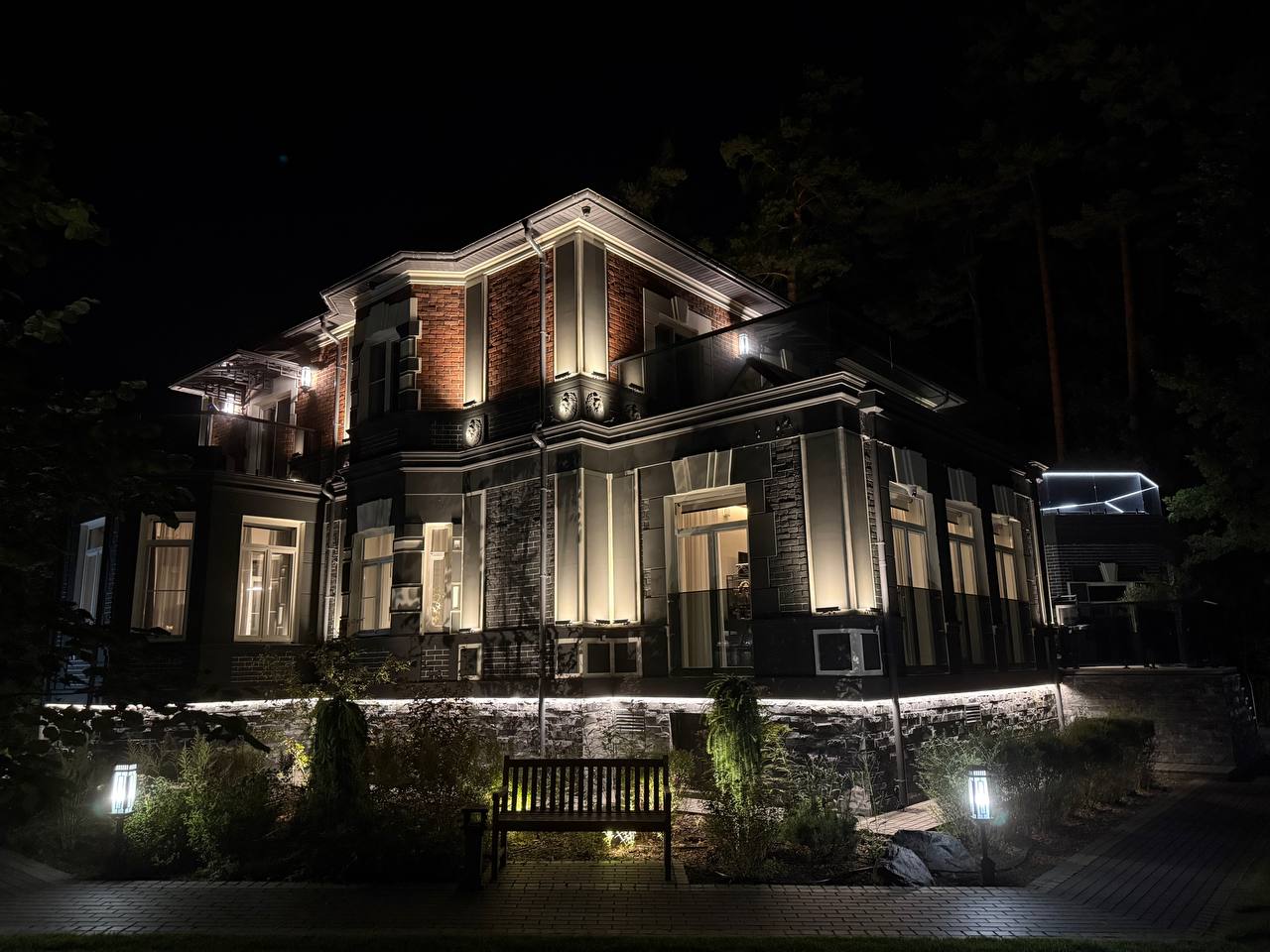
A private residence of 860 m² — basement plus two floors, with a pool area and a conservatory. We came in at shell stage and worked through to handover: design, programming, commissioning. The build ran from 2020 to 2022, and we have kept the installation in service ever since.
Challenge
At 2 000 group addresses an installation stops being a wiring job and becomes a documentation problem. Whoever opens the project in five years — us or somebody else — has to find one address among two thousand without reading the whole file.
Five vendors share the bus: Ekinex pushbuttons, Jung actuators and DALI gateways, Zennio inputs and heating boxes, HDL touch panels, and a CoolAutomation gateway for the VRF system. Each brings its own parameter model, and the VRF side speaks a proprietary protocol that has to be translated exactly once, in one place.
Underfloor heating adds a safety constraint the bus has to carry: every circuit needs its floor sensor, an over-temperature signal and a valve-flush status, not just a setpoint.
Solution
Group addresses are organised by function and floor, not by room or by device. Fifteen main groups: general, lighting per floor plus facade, shutters, ventilation, presence detectors, HVAC, underfloor heating per floor, climate sensors, pushbuttons.
Inside every lighting group the middle groups repeat in the same order — /0 switch, /1 switch status, /2 dimming, /3 brightness value, /4 brightness status, /5 detector block. Knowing the command address, an engineer derives the status address without opening the project.
Statuses live in their own middle groups rather than on neighbouring addresses. That keeps a bus trace of one function readable and lets a whole status group be filtered out at once during diagnostics.
Three bus lines, one per level; the line couplers filter traffic between them, so pushbutton telegrams on one floor do not load the other lines.
The visualisation was not bought, it was written — Node.js and React on the front end, Python for the integration services. The owner runs and configures the whole installation from a web app on iOS and Android and sees the state of every system; a Telegram bot carries alarms and basic control; a local file server belongs to the same infrastructure. A bought visualisation ties the client to one vendor and to that vendor's release cycle. This one does not.
Dispatching and monitoring
The bus does not only switch loads. The server rack, the electrical intake, leak protection, the pool plant and the whole climate side — air handling units, humidifiers, air conditioners, underfloor heating circuits, temperature and humidity sensors — all report their state into the same system.
Over four years that produced three interventions that would not have happened otherwise. Five water leaks were found and localised before any damage occurred. A humidifier developed a fault that showed up in its telemetry, and the unit was taken off power the same day. A damaged facade lighting cable was identified by the current leaking through it.
Monitoring in a private house is usually treated as an indulgence. Over four years here it has paid for itself three times over — and one of those times it took equipment off power before an overheating fault could go any further.
Systems & Technologies
Built in-house
In numbers
- Water leaks prevented
- 5Water leaks prevented
- Main groups
- 15Main groups
- Middle groups
- 78Middle groups
- Addresses named of 2 020 allocated
- 1 579Addresses named of 2 020 allocated
- Vendors on one bus
- 5Vendors on one bus
- Bus lines
- 3Bus lines
- Datapoint types in use
- 14Datapoint types in use
Project Details
- Property type
- Private residence
- Area
- 860 m²
- Commissioned
- 2022
- Technologies
- KNXDALI
Get a Preliminary Estimate
Explore the actual project
860 m² residence · 148 KNX devices · 1 579 named group addresses
Loading group addresses…
Result
The structure held. 441 addresses were left free on purpose, and every extension since has fitted into the existing scheme without renaming anything. The full anonymised group address list is published above — download it and check the naming yourself.
Four years in service, three incidents caught before they became damage, and the installation still runs on the documentation it was handed over with.
Related reading
How to structure 2 000 KNX group addresses so they are still readable after four years
At 200 addresses the structure does not matter. At 2 000 it decides whether the project can be maintained at all — a real scheme from an 860 m² installation, with the full list published.
Read articleThe ETS 6 group address import format, explained
Nine columns, and the level of an entry is decided by which column carries the name. The format documented, the pitfalls listed, and a generator published under MIT.
Read articleOne project table, two systems: killing duplicate data entry
The same address gets typed into ETS, into the controller config, and into the handover documentation. A year later all three disagree and none of them is authoritative.
Read articleDoes a Smart Home Pay for Itself Through Energy Savings?
An honest breakdown of where home automation saves money — and where it does not. Based on four years of operating an 860 m² KNX installation.
Read article